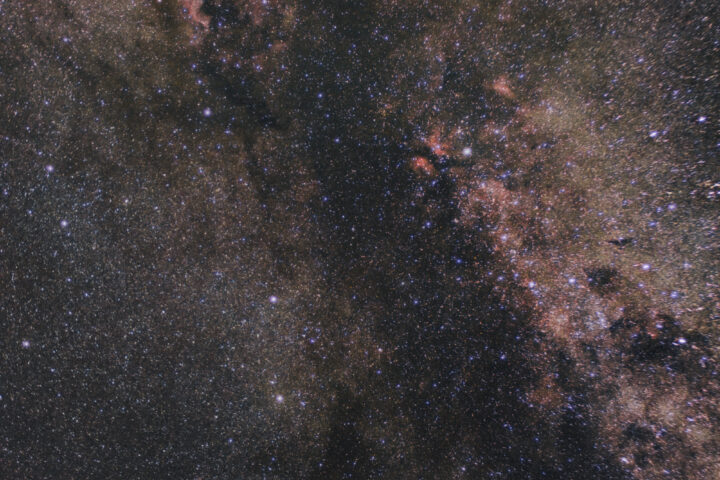
It’s hard to believe, but summer’s over. I absolutely had to take one last astrophoto before moving to the Bortle 8 skies that I’ll have to deal with this winter. What better target to shoot than the legendary Messier 31, the Andromeda Galaxy.
My image

Image specs
CAMERA: Olympus Pen F (unmodified)
LENS: Olympus 75-300 @300mm f/6.7
MOUNT: Skywatcher EQ-3 Pro Synscan
GUIDING: QHY5L-II monochrome + Celestron Firstscope 76
EXPOSURES: 20x300s unfiltered
LIGHT POLLUTION: Bortle class 5
Acquisition
This is one of my few images with more than one hour of integration and that’s because I started shooting very early, at around 9:45 PM, and it continued shooting automatically until the camera’s battery died.
By looking at the subexposures, I noticed just how important it is to shoot when the target is at the zenith. Look at how much darker the last exposure is compared to the first one, which was shot when Andromeda was still low in the sky.


Processing
As usual, I stacked my photos using Deep Sky Stacker without dark or bias frames but with flats. After that, I opened the stack in Photoshop and started stretching the image, when I noticed a darker and greener horizontal line. I don’t know the exact cause of this phenomenon, also because this is the very first time this has ever happened. I corrected it using a levels adjustment with a layer mask, but you can still se a hint of it in the final image.


After that, I discovered that the picture was full of gradients. They are particularly noticeable here. Note that this is a processing step of the first iteration of this image. The final result is actually version five or six.

Luckily, I was able to compensate for these effects using circular gradient masks. I later used selective color correction to remove some remaining magenta patches and I selectively desaturated the background.
After all these hassles it was just a matter of normal editing.
Conclusion
Just like the picture of the North America Nebula, this image really put my processing skills and especially my patience to a test. However, the result was 100% worth it and I’ll make sure to capture this target again next summer since don’t think shooting it under Bortle 8 skies would lead to a photo any better than this one.
Lagoon and Trifid nebulae, Andromeda Galaxy… I only need to capture the Pleiades and the Orion Nebula (properly) and I’ll have shot the most famous beginner deep sky targets.